
Higher petrol prices have limited effect on transport emissions growth—LEEM analysis shows
by Brad Vakulcyzk
Key Data Insights
| The 2026 oil price shock showed that even when petrol gets much more expensive, people still drive nearly as much in the short term. Without policy action on alternatives, transport emissions are likely to keep growing.
Analysis using NIEIR’s Local Energy and Emissions Monitor (LEEM) shows:
|
Transport Sector Emissions
Transport sector emissions show signs of growth in recent years in direct contrast to slowing or declining emissions within other sectors. The recent oil price shock has raised concerns about the security and price of petroleum fuel, which may boost long-term uptake of clean transport alternatives and help slow or reduce future transport emissions.
Analysis presented here draws on NIEIR’s Local Energy and Emissions Monitor (LEEM) and petroleum product sales data, allowing transport emissions trends to be examined alongside fuel consumption and vehicle market conditions across Australia.
The transport sector is the second largest greenhouse gas emissions sector, making up around 22.6 per cent of total Australian emissions. Transport is second only to the electricity sector (33.2 per cent). The key difference between the two sectors is that the electricity sector is rapidly decarbonising with increased renewable energy, while transport emissions continue to grow with the sector still largely dependent on petroleum fuels.
Australian emissions sharply decreased during the COVID lockdown periods (2019-20 and 2020-21), corresponding to restrictions that limited travel and economic activity. Most sectors have remained subdued post-COVID, or continued to decrease, as in the case of the electricity sector.
In contrast to other sectors, transport sector emissions increased post-COVID with the return of commuting and a permanent increase in commercial delivery services. Traffic has increased since COVID-19, but at levels lower than would likely have been the case had COVID-19 not spurred on working from home arrangements. Freight and last-mile delivery services have also increased substantially since COVID-19 with the rise of food delivery and parcel services.
The transport sector has had the largest absolute increase in sectoral emissions from 2004-05 to 2024-25. Transport sector emissions in 2024-25 were 21 per cent above 2004-05 levels. In contrast, electricity sector emissions were 25 per cent below 2004-05 levels while fugitive emissions and IPPU have been trending downwards from pre-2019 peak levels.
Table 1: Change in Australian greenhouse gas emissions by sector from 2004-05 to 2024-25
| Year | Electricity | Stationary energy excl. electricity | Transport | Fugitive emissions | IPPU | Agriculture | Waste | LULUCF |
| 2019 | -9% | 21% | 22% | 36% | 8% | -12% | -16% | -179% |
| 2020 | -13% | 22% | 13% | 29% | 6% | -15% | -14% | -179% |
| 2021 | -17% | 26% | 10% | 16% | 9% | -9% | -14% | -217% |
| 2022 | -20% | 26% | 9% | 15% | 9% | -8% | -11% | -208% |
| 2023 | -22% | 22% | 18% | 14% | 10% | -5% | -12% | -196% |
| 2024 | -22% | 20% | 20% | 11% | 2% | -7% | -12% | -196% |
| 2025 | -25% | 17% | 21% | 6% | 0% | -7% | -12% | -196% |
Source: Quarterly Update of Australia’s National Greenhouse Gas Inventory: September 2025, Department of Climate Change, Energy, the Environment and Water
Petroleum Product Consumption
Changes in the transport sector are reflected through sales of petroleum products over the past 15 years. Figure 1 shows sales of automotive petrol (gasoline), diesel oil and LPG for automotive use. Automotive petrol and diesel are split into retail sales and non-retail sales, while automotive LPG is presented as a total.
The Australian Petroleum Statistics reflect all sales of petroleum products, which includes both automotive use and other usage such as stationary energy. This is most prevalent in diesel oil sales, which is used heavily for power generation in remote areas, including mining.
Retail sales of automotive petrol have been trending downwards and remain well below 2018-19 levels due to a range of factors, including:
However, retail sales of diesel oil have been trending upwards, albeit at a slower pace than pre-COVID growth, as the popularity of larger vehicles increased, including diesel-powered SUVs and utes. Sales of automotive LPG have gone from a small segment of petroleum sales in 2010 to almost negligible in 2025.
The most significant growth in petroleum usage is in direct sales of diesel to commercial and industrial customers, which includes both automotive (e.g. freight) and non-automotive usage. Direct sales of automotive petrol have been relatively stagnant since 2017.
Figure 1: Petroleum product sales, select road transport petroleum indicators
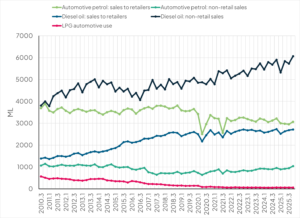
Source: Australian Petroleum Statistics, Department of Climate Change, Energy, the Environment and Water. Note: Contains sales of petroleum products for non-transport usage.
Transport sector emissions have also grown post-COVID from the return of international and domestic air travel. Purchases of aviation fuel for domestic travel returned quickly, even exceeding 2019 levels by 2023, as there was still some hesitation about international flights and perceived risk of border closures. Aviation fuel for international flights is still increasing and remains below 2019 levels.
Table 2: Australian petroleum product sales by fuel and segment (megalitres)
| Fuel | Segment | 2011 | 2015 | 2019 | 2020 | 2021 | 2022 | 2023 | 2024 | 2025 | Avg growth 2019–25 |
| Automotive Petrol | Retail sales | 14,650 | 14,000 | 14,650 | 13,144 | 12,771 | 12,044 | 12,835 | 12,509 | 12,324 | -2.8% |
| Non-retail sales | 4,276 | 4,189 | 2,921 | 2,932 | 3,234 | 3,099 | 3,307 | 3,637 | 3,669 | 3.9% | |
| Total | 18,926 | 18,189 | 17,571 | 16,076 | 16,006 | 15,143 | 16,142 | 16,146 | 15,993 | -1.6% | |
| Diesel Oil | Retail sales | 5,599 | 7,403 | 10,045 | 9,828 | 10,210 | 10,138 | 10,766 | 10,492 | 10,554 | 0.8% |
| Non-retail sales | 15,835 | 18,735 | 19,210 | 19,727 | 19,976 | 20,936 | 21,344 | 22,468 | 22,746 | 2.9% | |
| Total | 21,434 | 26,138 | 29,255 | 29,554 | 30,186 | 31,074 | 32,110 | 32,959 | 33,300 | 2.2% | |
| LPG | Automotive use | 2,017 | 1,469 | 591 | 514 | 354 | 282 | 261 | 242 | 246 | -13.6% |
| Aviation turbine fuel | Domestic | 2,998 | 3,875 | 3,446 | 2,762 | 1,883 | 2,410 | 3,714 | 3,964 | 4,087 | 2.9% |
| International | 4,070 | 4,268 | 5,989 | 4,591 | 1,499 | 2,100 | 3,767 | 5,057 | 5,529 | -1.3% | |
| Total | 7,068 | 8,143 | 9,434 | 7,353 | 3,382 | 4,510 | 7,481 | 9,021 | 9,616 | 0.3% | |
| Aviation gasoline | Total | 79 | 68 | 67 | 59 | 63 | 62 | 67 | 70 | 73 | 1.4% |
Source: Australian Petroleum Statistics, Department of Climate Change, Energy, the Environment and Water
What are the Short and Long-Term Effects of the 2026 Oil Price Shock?
While transport sector emissions continued to show signs of growth in contrast to stationary energy emissions, events in the Middle East in early 2026 have raised concerns about the cost and security of petroleum fuel supply.
In the short term, people may try to adjust to higher petrol prices. In the long term, sustained higher petrol prices will likely bring forward adoption of electric vehicles. Behavioural change is a short-term response to changes in petroleum prices, while purchasing a new vehicle such as an EV is a long-term response.
The Federal Government has responded by temporarily reducing fuel excise to reduce prices paid by consumers and has also worked with international suppliers to ensure future fuel supply.
In the Short Term it’s Difficult to Reduce Petrol and Diesel Consumption
Petrol consumption is traditionally price inelastic, which means that petrol price changes do not lead to major swings in petrol demand. For a car-dependent economy, transportation of goods and personal transportation remain essential and can be difficult to avoid. Automotive diesel consumption exhibits similar behaviour.
Short-term reductions may include, but are limited in practicality:
Arguably, people may become more responsive to increases in petrol prices when there are more readily available transport substitutes. This includes:
Use of petroleum products in commercial and industrial transportation of goods are more difficult to substitute in the short term.
NIEIR Estimates of Short-Term Petrol Price Elasticity
NIEIR has estimated the short-term price elasticity of petrol demand using quarterly data from 2010 to December 2025. The sample was split into pre-2020 observations and post-2021 observations, when lockdowns and border closures had largely been lifted after vaccines became readily available. The 2020 and 2021 years were excluded from the analysis because of the abnormal impact on transport through lockdowns and border closures.
NIEIR finds that there is weak evidence that people may be becoming more demand-responsive to real changes in petrol prices. The price elasticity of petrol demand is around -0.08 in the pre-2020 sample compared to around -0.12 in the post-2021 sample. Both estimates are price inelastic.
People have a limited ability to adjust petrol consumption in the short term. This remains true in recent years even under greater workplace flexibility.
In the pre-2020 sample, a 1 per cent increase in average petrol prices over the quarter results in a -0.08 per cent decrease in automotive petrol consumption. Similarly, a 1 per cent price increase post-COVID leads to a -0.12 per cent decrease in petrol consumption.
Average prices increased from around 183 cents per litre in the December 2025 quarter to an average of around 220 cents per litre in the first quarter of 2026. The increase in petrol prices of 20.9 per cent would be expected to lead to a 2.4 per cent reduction in total Australian petrol consumption, under otherwise average economic conditions.
These are responses to price changes under typical market conditions. If the oil price shock leads to negative economic growth or recession, this will adversely affect petrol consumption through loss of employment and income.
Long-Term Implications for Transport Sector Emissions
A significant development over the past 15 years has been the rapidly expanding market for plug-in electric vehicles, and in particular expanding market share over the past two to three years.
Australia aims to reduce national greenhouse gas emissions by 2035 to 62 to 70 per cent below 2005 levels and reach net zero emissions by 2050. Plug-in electric vehicles and continued increases to renewable energy generation are critical to reduce transport sector emissions and meet these goals.
The purchase of a new vehicle is a long-term decision. It is not feasible for the vast majority of people to switch to a more efficient or electric car when the price of petrol increases. However, current circumstances will influence those who are already in the market for a new car.
A Surge in EV Sales
There has been a recent surge in EV sales as a result of high petrol prices and concerns about fuel security.
March 2026 sales of EVs were approximately 14.6 per cent of vehicle sales according to VFACTS data, or a total of 15,839 vehicles. Sales of EVs in March 2026 were over double that of January 2026, or around 84 per cent higher than average monthly sales during 2025.
Reports for the second-hand market show a similar trend to the new car market, with sales of second-hand EVs more than doubling from February to March 2026. Short-term supply constraints within the second-hand car market will likely be of more concern with available stock low from excess demand.
While this is a significant increase in electric vehicle sales for March 2026, this still means that 85.4 per cent of new car sales involved internal combustion engines, whether purely petrol or diesel, or a hybrid.
Fleet Transition and the Path to Net Zero
The average age of motor vehicles on the road is around 10 years, which means that many vehicles purchased today will still be on the road by 2035. Many cars are even older, which has implications for vehicles on the road by 2050 and the ability to meet net zero targets.
Petroleum products used in transport are going to continue for the medium to long term. Vehicles with an internal combustion engine still make up the vast majority of vehicles on the road today (over 98 per cent) when compared to fully electric vehicles (under 2 per cent). While purely electric vehicles have become more mainstream over the past couple of years and there has been significant interest in EVs since the oil shock in February and March 2026, they still represent a minority in annual motor vehicle sales and for all on-road vehicles.
Fuel Supply Security
The current oil crisis has also highlighted concerns about fuel supply security, for which Australia is heavily dependent on imports of automotive petroleum products. This has already been the case for many years, but the crisis has raised public awareness about the issue, even though the level of imports and days of petroleum in reserve have been relatively consistent in recent history.
These security concerns can be alleviated by purchasing an EV and charging from local electricity supply rather than foreign energy supply. Even if the price of petrol comes down and current world supply returns, concerns about fuel supply may also drive people toward electric vehicles.
The Takeaway
|
This analysis illustrates that higher fuel costs have limited impact on driving in the short term. Structural issues mean people can’t easily switch to other transport modes and without alternatives, expensive petrol just makes driving more painful, not less frequent. The short-term window created by current fuel price and supply concerns offers an opportunity to build infrastructure now, while public attention attracts support for action. Those acting now will have charging networks established, freight strategies embedded and transit alternatives in place before 2035 targets tighten. Those that delay will face compressed timelines, higher costs and unmet climate commitments. The structural challenge is clear: Australia’s transport emissions won’t be solved by market forces alone. Policy, infrastructure investment and long-term planning will. |
About the Data
This analysis draws on NIEIR’s Local Energy and Emissions Monitor (LEEM), which tracks energy use, emissions and transport trends across Australia’s Local Government Areas. LEEM enables detailed analysis of how the energy transition is unfolding across different regions and communities.
For more information, contact NIEIR at info@nieir.com.au or visit nieir.com.au
Notes
References
Department of Climate Change, Energy, the Environment and Water — Quarterly Update of Australia’s National Greenhouse Gas Inventory: September 2025
Department of Climate Change, Energy, the Environment and Water — Australian Petroleum Statistics
Federal Chamber of Automotive Industries (FCAI) — VFACTS vehicle sales data, March 2026
Australian Automotive Dealer Association — Autograb second-hand vehicle sales data
NIEIR regional economic databases and Local Energy and Emissions Monitor (LEEM) click HERE to visit the NIEIR website and learn more